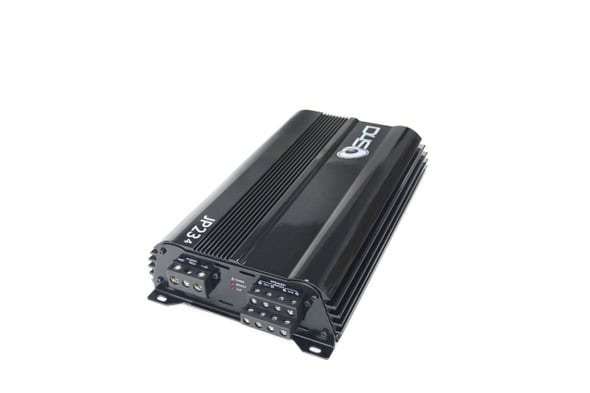
Choosing the right car amplifier comes down to four questions: what are you powering, how many channels do you need, what ohm load will you run, and how much RMS power is required. Answer those four and the right amp finds itself. This amp finder guide walks through each step with real numbers, so you can size an amp to your system instead of guessing, and it covers the 4 ohm amplifier question that confuses more buyers than anything else.
Step 1: Count Your Channels
The number of channels is decided by what you are powering:
- One subwoofer: a monoblock amp, one channel.
- A pair of speakers: a 2 channel amplifier.
- Four speakers: a 4 channel amplifier.
- Four speakers plus a sub: a 4 channel amp for the speakers and a monoblock for the sub.
If you are building a full system, the standard setup is a 4 channel amp for the doors and a mono amp for the bass. If you are on a budget, a 4 channel amp with the rear pair bridged can run a small sub, but a dedicated monoblock is the better long-term answer.
Step 2: Find the RMS Rating of Your Speakers
Look up the RMS rating of every speaker and sub you plan to power. This number is printed on the spec sheet, not the box. A subwoofer box that says 1200W in big letters usually has a 300W RMS rating in small print. The RMS number is the one that matters.
The rule: the amp should deliver 75 to 150 percent of the speaker’s RMS rating per channel at your ohm load. A 100W RMS speaker wants an amp with 75 to 150W RMS per channel. A 1000W RMS sub wants a monoblock with 750 to 1500W RMS. More headroom is safer than less, because a clipped amp is what actually damages speakers.
Step 3: Pick Your Ohm Load
Impedance, measured in ohms, is the load the speakers present to the amp. Lower ohms means more power, up to the amp’s limit. The three common loads:
- 4 ohm: the standard for most door speakers and many subs. A 4 ohm amplifier delivers its rated power into a 4 ohm load, and a 4 ohm amp is the most compatible choice for a mixed system.
- 2 ohm: common for subwoofers and some aftermarket speakers. The amp must be rated 2 ohm stable.
- 1 ohm: subwoofer territory. Only monoblocks and a few multi-channel amps go this low.
A 4 ohm amp is the safest, most universal pick: it runs cooler, draws less current, and works with nearly any speaker. The tradeoff is less power than the same amp at 2 ohms. If you want maximum output from a sub, wire it to 1 ohm and use a monoblock rated for it, like the JP1 1200W RMS any-ohm amplifier, which is rated at 4, 2, and 1 ohm.
Wiring to Your Target Load
- One dual 4 ohm voice coil sub, parallel: 2 ohms.
- One dual 2 ohm voice coil sub, parallel: 1 ohm.
- Two dual 4 ohm subs, parallel: 1 ohm.
- Two 4 ohm speakers per channel, parallel: 2 ohms.
Never run an amp below its rated minimum impedance. Check the spec sheet before you wire.
Step 4: Read the Spec Sheet, Not the Model Name
Model numbers like 2000 x 4, 3000×4, or 3000 2 are marketing, not output. The real numbers are in the spec sheet:
- RMS per channel at 4 ohms.
- RMS per channel at 2 ohms.
- RMS bridged at 4 ohms (for multi-channel amps).
- Minimum ohm stability.
- Signal to noise ratio, ideally above 90 dB.
- Fuse rating, which hints at real output. Roughly, an amp’s RMS output in watts is about 10 times its fuse rating in amps.
If an amp has a 40 amp fuse, it cannot deliver 2000W RMS. Physics does not care about the model name.
Step 5: Check Your Electrical System
The amp is only as good as the power feeding it. Rough current draw is RMS output divided by efficiency, plus a margin. A 500W RMS class D amp draws about 50 amps. A 1200W RMS amp draws about 100 to 120 amps. A 5000W RMS amp draws 400 to 500 amps.
Match your wiring and charging to the draw:
- Up to 600W RMS: 8 gauge wire, stock alternator is usually fine.
- 600 to 1500W RMS: 4 gauge wire, healthy battery, stock alternator OK for daily use.
- 1500 to 3000W RMS: 0 gauge wire, AGM battery, high output alternator recommended.
- 3000W RMS and up: 0 gauge wire, second battery, high output alternator required.
If voltage sags under load, the amp clips, and clipping kills speakers. Budget for the electrical side before you buy the amp.
What About Amplified Bass?
If your goal is amplified bass, the formula is simple: one monoblock, one sub (or a pair), wired to the lowest ohm load the amp supports, with a subsonic filter if the box is ported. A 1200W RMS monoblock on a 1000W RMS sub is the classic daily driver setup. For more output, step up to a 5000 watt amp and the electrical system to match. The monoblock amp guide covers the details.
Ready to find your amp? Browse car amplifiers for every build at Down4Sound, and use the category pages to narrow it down: monoblock amps for subwoofers, 4 channel amps for full-range systems, and 2 channel amps for pairs. If you already know you need around 1200W RMS, the JP1 1200W RMS any-ohm amplifier is the one to start with.
Choosing an Amplifier: Quick Answers
How many channels do I need?
Count what you are powering. One subwoofer needs one channel, a pair of speakers needs two, and four speakers need four. A full system with four speakers and a sub usually runs a 4 channel amp for the speakers plus a monoblock for the bass.
How much RMS power matches my subs?
Aim for 75 to 150 percent of the sub’s RMS rating at the final ohm load. A 1000W RMS sub pairs well with an amp that delivers 750 to 1500W RMS. A little headroom is safer than too little, because a clipped amp is what damages speakers.
What does ohm stability mean?
Ohm stability is the lowest impedance an amp can drive safely. A 2 ohm stable amp can run a 2 ohm load without overheating. Never wire a load below the amp’s rated minimum.
Class D vs class AB for full range sound?
Class D is smaller, runs cooler, and draws less current, so it fits most builds. Class AB can sound slightly warmer but turns more power into heat. For full range speakers, a class D amp with a signal to noise ratio above 90 dB is the practical choice.
Where should I mount my amplifier?
Mount it where it gets airflow and stays dry: under a seat, on an amp rack in the trunk, or on the back of the sub box. Keep the power cable on one side of the car and the RCA signal cables on the other to avoid alternator whine.
Related Guides
- 2 Channel Amplifier Guide: Uses, Power, and Wiring
- Car Amplifier 4 Channel: What to Know Before You Buy
- 5000 Watt Amp: Real Power, Real Electrical Demands
- Motorcycle Amplifier Guide: Power Your Ride’s Audio
The right amp is the one that matches your subs, your electrical, and your goals. Browse the car amplifiers at Down4Sound, from compact monoblocks to full competition power. Financing is available so you can get the right amp now and pay it off as the build comes together.