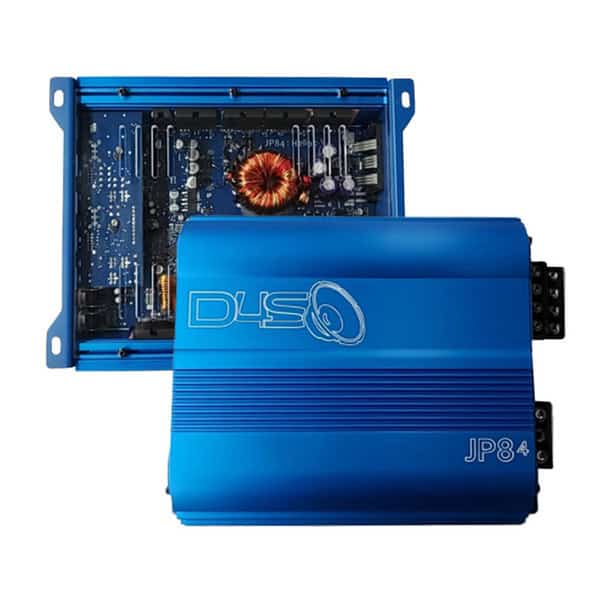
A car amplifier 4 channel is the workhorse of a full-range system. It powers your front and rear door speakers with clean, dedicated wattage, and it can even run a subwoofer when you bridge the rear channels. If you want your mids and highs to keep up with your bass, a 4 channel amp is the upgrade that makes it happen. This guide covers RMS ratings, bridging, ohm loads, and how to pick the best 4 channel amp for your build.
What Does a 4 Channel Car Amplifier Do?
A 4 channel amplifier has four independent output channels, usually arranged as two pairs. The standard setup is simple: channels 1 and 2 drive the front speakers, channels 3 and 4 drive the rear speakers. Each channel gets its own gain, crossover, and bass boost controls on most models, so you can tune the front stage and rear fill separately.
Four channels also give you flexibility. You can run a component set up front and coaxials in the rear, bi-amp a set of components with two channels per side, or bridge the rear pair to drive a subwoofer. That last option is why many people start with a 4 channel amp: it powers the whole system, speakers and sub, with one chassis.
4 Channel vs 2 Channel vs Monoblock
- A 4 channel amp powers four speakers, or two speakers plus a bridged sub.
- A 2 channel amplifier powers a pair of speakers, or one sub bridged.
- A monoblock amp powers a subwoofer only, with maximum wattage and low-ohm stability.
If you are building a complete system, the classic combo is a 4 channel amp for the doors and a monoblock for the sub. That is the setup we recommend in our monoblock amp guide, and it is what most serious installs run.
RMS Ratings: What 2000 x 4, 2800 4, and 3000×4 Really Mean
Amplifier model numbers are the most confusing part of shopping. A model called 2000 x 4 or 3000×4 is almost never 2000 or 3000 watts RMS per channel. Those numbers are usually peak or max ratings for the whole amp, or a sum of all channels at their lowest rated impedance.
What you actually need is the RMS rating per channel at 4 ohms and at 2 ohms. For example:
- A 2000 x 4 model might deliver 150W RMS x 4 at 4 ohms and 250W RMS x 4 at 2 ohms.
- A 2800 4 model might deliver 200W RMS x 4 at 4 ohms and 350W RMS x 4 at 2 ohms.
- A 3000×4 model might deliver 250W RMS x 4 at 4 ohms and 400W RMS x 4 at 2 ohms.
The exact numbers depend on the amp, so read the spec sheet, not the model name. A good 4 channel amp for door speakers delivers 75 to 150W RMS per channel at 4 ohms, which is plenty for most component sets. If you are running high-power midbass drivers, look for 200W RMS per channel or more at 4 ohms.
Bridging a 4 Channel Amp for a Subwoofer
Bridging combines two channels into one higher-power channel. On a 4 channel amp, you bridge channels 1 and 2, or 3 and 4, by using the left positive and right negative terminals of the pair. Bridged output is typically three to four times a single channel’s 4 ohm rating, but the amp sees half the impedance per channel, so a bridged 4 ohm load looks like 2 ohms per channel.
The catch: most 4 channel amps are only stable to 2 ohms per channel, which means a bridged load below 4 ohms is out of spec. A bridged sub on a 4 channel amp should be a single 4 ohm sub, or dual voice coil wired to 4 ohms. If you want to run a sub at 1 or 2 ohms, use a monoblock instead. That is why the best 4 channel amp setups pair a 4 channel for the doors with a mono amp for the sub, like the JP1 1200W RMS monoblock.
Class D vs Class A/B for 4 Channel Amps
For years, 4 channel amps were class A/B, prized for clean sound but inefficient and hot. Modern class D 4 channel amps changed that. They run cool, draw less current, and fit in smaller chassis, and the sound quality gap has essentially closed for car audio use.
Class D is the right choice for almost everyone now. It matters even more if you are running a 2000 x 4 or 3000×4 class amp, because the current draw of a big class A/B amp at full tilt would demand a serious alternator upgrade. A class D 4 channel amp gets the same output with roughly half the current draw.
How to Choose the Best 4 Channel Amp
Match the amp to your speakers, not the other way around. Check the RMS rating of your speakers, then pick an amp that delivers 75 to 150 percent of that per channel at the ohm load you will run. Most door speakers are 4 ohm, so the 4 ohm RMS rating is the one that matters.
Checklist for a 4 Channel Amp
- RMS per channel at 4 ohms and 2 ohms, not peak or model-name wattage.
- High-pass and low-pass crossovers per channel pair, so you can run speakers and a bridged sub from one amp.
- 2 ohm stereo stability if you plan to run 2 ohm speakers or bridge for a sub.
- Signal-to-noise ratio above 90 dB for clean output.
- Remote bass knob if you plan to bridge a sub.
- Fuse rating and wire size requirements, usually 4 gauge for most 4 channel amps.
Common 4 Channel Amp Mistakes
- Buying on the model number. 3000×4 does not mean 3000 watts per channel.
- Bridging into a 2 ohm load on an amp that is only 2 ohm stable per channel.
- Running the high-pass filter on subwoofer channels, or the low-pass on door speakers.
- Setting gains by ear with the bass boost cranked, which clips the amp and burns tweeters.
- Underfeeding the amp. A big class D 4 channel still needs proper gauge wire and a clean ground.
Ready to upgrade? Shop 4 channel car amplifiers at Down4Sound, check the Down4Sound 4 channel lineup for class D amps rated in real RMS, and pair your new 4 channel with the JP1 1200W RMS monoblock for bass. If you only need to power a pair of speakers, our 2 channel amp guide covers that route, and the amp finder guide walks through sizing any amp to your system.
4 Channel Amp FAQ
Can I run speakers and a sub on a 4 channel amp?
Yes. Run your front speakers on channels 1 and 2, then bridge channels 3 and 4 to power the sub. Keep the bridged sub at a 4 ohm minimum, since most 4 channel amps are only stable to 2 ohms per channel, which equals 4 ohms bridged. If you want to run a sub at 1 or 2 ohms, add a monoblock instead.
How do I wire 4 speakers to a 4 channel amp?
Wire one speaker per channel: front left, front right, rear left, rear right. Connect each speaker’s positive and negative leads to the matching channel terminals, then engage the high-pass filter for the door speakers and set gains with a clean signal. Four 4 ohm speakers give each channel a 4 ohm load, which is the RMS rating to shop by.
What size power wire does a 4 channel amp need?
8 gauge OFC power wire covers most 4 channel amps up to about 800 watts RMS. Above that, step up to 4 gauge OFC, and use the same gauge for the ground run. Size your wire by RMS wattage, because RMS is the only power number that matters.
Do I need an amp for factory speaker upgrades?
Factory head units only make about 15 to 20 watts per channel, so new speakers will play but stay quiet and flat. A 4 channel amp delivering 75 to 150W RMS per channel gives them clean volume and real control. Without an amp, you leave most of what you paid for on the table.
Keep Reading
- Amp Finder Guide: How to Choose the Right Car Amplifier
- Wakeboard Tower Speakers Buying Guide: Size, Power, Mounting
- 1200 Watt Amp Guide: What 1200W RMS Really Gets You
One good four channel amp can wake up every speaker in the car at once. Start with the car amplifiers at Down4Sound, from compact monoblocks to full competition power. Financing is available with easy monthly payments if you want to keep cash free for the rest of the install.