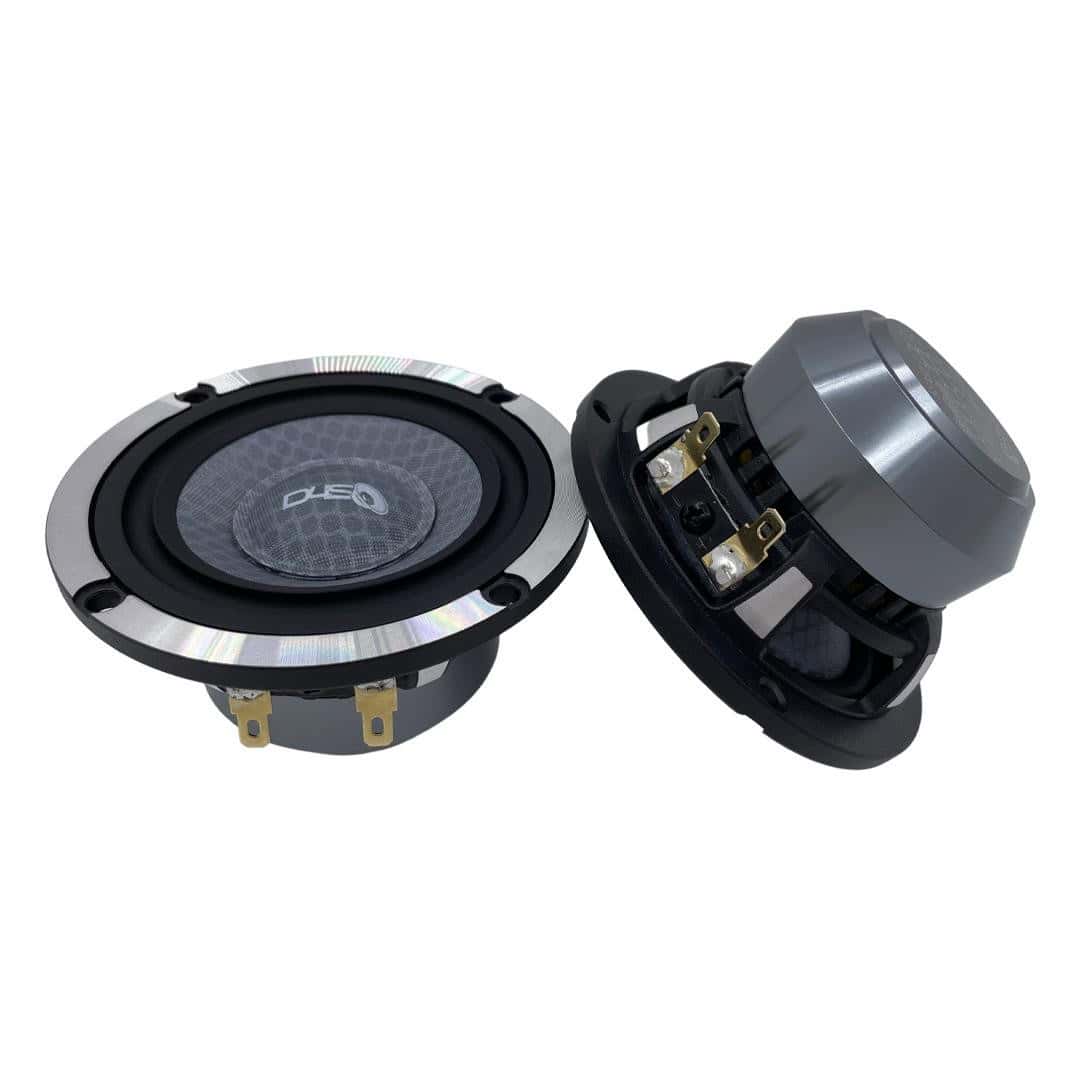
Bass blockers for tweeters are the cheapest insurance in car audio. A tweeter is a small driver built to reproduce high frequencies, and feeding it bass it cannot handle is the fastest way to burn a voice coil. A bass blocker is a capacitor wired in series with the tweeter that blocks low frequencies and passes highs, protecting the driver and cleaning up the sound. This guide covers the capacitor math, how to pick the right crossover point, and how to install them.
What a Bass Blocker Actually Does
A bass blocker is a non-polarized capacitor, usually rated in microfarads (uF), wired in series with the positive lead of the tweeter. A capacitor blocks DC and low frequency AC, and passes high frequency AC. The frequency where the tweeter starts getting signal is the crossover point, and it is set by the capacitor value and the tweeter’s impedance.
The result is a high-pass filter. Frequencies below the crossover point are attenuated, and frequencies above it pass through. The tweeter only sees the range it was built for, which means it plays louder and cleaner without the risk of mechanical or thermal damage from bass.
The Capacitor Math: How to Pick the Right Value
The crossover frequency is calculated with the standard high-pass formula:
C = 1 / (2 x pi x F x Z)
Where C is capacitance in farads, F is the crossover frequency in hertz, and Z is the tweeter impedance in ohms. In practical terms, for a 4 ohm tweeter:
- 3,000 Hz crossover: about 13 uF
- 4,000 Hz crossover: about 10 uF
- 5,000 Hz crossover: about 8 uF
- 6,000 Hz crossover: about 6.5 uF
For an 8 ohm tweeter, halve the capacitance for the same crossover point. A 4 ohm pair of bass blockers rated around 10 uF gives roughly a 4 kHz high-pass, which is the sweet spot for most component-style installs where the midrange handles everything below.
The slope is 6 dB per octave, which is gentle. That is fine for tweeter protection, because the tweeter’s own natural rolloff below its resonant frequency adds protection on top. If you need a steeper slope, you need a real crossover network, not a single capacitor.
Bass Blocker vs Crossover: Know the Difference
A bass blocker is a single capacitor, a first-order high-pass filter. A real crossover network uses capacitors and inductors to split the signal between drivers with a steeper slope, and it is what you get in a component set’s crossover box. If you are running a component set with a passive crossover, you do not need bass blockers, the crossover already handles it.
Bass blockers are for the other cases: adding tweeters to a system running on a full range signal, protecting 6x9s or coaxials that are getting too much bass, or running tweeters directly off an amp channel without a crossover. They are also the standard fix when a factory system has no high-pass filtering and the tweeters are distorting.
How to Install Bass Blockers
Installation is a 15 minute job:
- Disconnect the battery or at least the amp, so you do not short anything while working.
- Cut the positive speaker wire to the tweeter, close to the tweeter so the blocker is easy to reach later.
- Solder or crimp the capacitor in series with the positive lead. The capacitor is non-polarized, so orientation does not matter, but it must be in series, not parallel. Wiring it across the terminals shorts the signal.
- Insulate the connection with heat shrink or electrical tape. A bare capacitor body touching chassis metal is a short waiting to happen.
- Reconnect and test. The tweeter should play clean highs with no bass, and the midrange should carry the low end.
Use quality speaker wire for the connections. If you want bass control from the driver seat, a remote level knob on the amp is the cleanest way to dial in the low end. A speaker wire and cable run with clean solder joints keeps the signal path solid, and it matters more with a capacitor in the path because every connection is a potential failure point.
Buying Guide: What to Look For
- Capacitor value. Match the uF rating to your tweeter impedance and desired crossover point. A 4 ohm pair rated around 10 uF is the most common choice.
- Voltage rating. The capacitor should be rated well above the system voltage, 50V or higher. Cheap 16V caps fail when the amp clips.
- Non-polarized. Audio capacitors must be non-polarized. Polarized electrolytic caps fail in AC signal paths.
- Pair packaging. Buy matched pairs so both tweeters get the same crossover point. Mismatched caps cause uneven imaging.
- Build quality. A cap with a molded housing and tinned leads survives vibration. Bare film caps crack at the leads in a door panel.
Common Mistakes
- Wiring the cap in parallel. A parallel cap shorts the high frequencies to ground and does nothing to protect the tweeter. Series only.
- Using the wrong value. A cap that is too large (like 50 uF) sets the crossover too low, around 800 Hz, and the tweeter still gets bass it cannot handle. A cap that is too small starves the tweeter of its range.
- Skipping the midrange. Bass blockers protect the tweeter, but the midrange driver still needs to handle the low end. If the midrange is small, it needs protection too.
- Forgetting the slope. A 6 dB slope is gentle. If the tweeter still distorts at high volume, the crossover point is too low or the tweeter is underpowered for the system.
Get a matched tweeter crossover bass blocker pair at Down4Sound, rated for 4 ohm tweeters with the right capacitor value for a clean high-pass install.
Common Questions About Bass Blockers
What do bass blockers do for tweeters?
A bass blocker is a capacitor wired in series with the positive tweeter lead. It blocks low frequencies and passes the highs, so the tweeter only plays the range it was built for. That protects the voice coil from bass it cannot handle and cleans up the top end.
What capacitor value do my tweeters need?
Use the formula C = 1 / (2 x pi x frequency x impedance), which gives farads, then convert to microfarads. A 4 ohm tweeter with a 5,000 Hz crossover needs about 8 uF. For an 8 ohm tweeter, halve the capacitance for the same cutoff.
Where do bass blockers get installed?
Inline on the positive tweeter lead, close to the tweeter. Solder or crimp the capacitor in series, then insulate the joints with heat shrink or tape so nothing can touch chassis metal.
Bass blockers vs a crossover: which do I need?
A bass blocker is a single capacitor with a gentle 6 dB per octave slope, which is enough for tweeter protection on a full range signal. A component set with a passive crossover already filters the tweeter, so you do not need blockers there. Pick a real crossover network when you need a steeper slope or you are splitting signal between multiple drivers.
Next Reads
- 6.5 Speaker Pods for Trucks: Fitment, Sound and Setup
- 2 Channel Amplifier Guide: Uses, Power, and Wiring
- Amp Finder Guide: How to Choose the Right Car Amplifier
The math is done, so all that is left is matching the cap to your crossover point. Shop the speakers and tweeter gear at Down4Sound. Financing is available if you want to roll caps and speakers into one checkout.