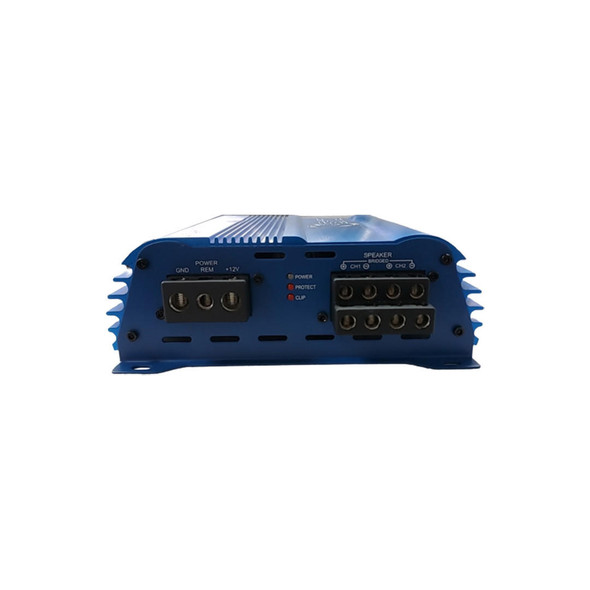
A 5000 watt amp is where car audio stops being a hobby and starts being a statement. A true 5000W RMS monoblock will move serious air, but it also demands a serious electrical system, proper wiring, and a subwoofer that can actually take the power. This guide covers what this class of amp really delivers, what it needs from your vehicle, and how it compares to 3500 watt and 10000 watt options.
5000 Watts RMS vs 5000 Watts Peak
Here is the trap: most amps labeled 5000 watts are 5000 watts peak, which means roughly 2500W RMS. A genuine 5000 watt amplifier rated 5000W RMS at 1 ohm is a completely different machine.
When you compare amps in this class, compare the RMS rating at 1 ohm. That is the number that tells you what the amp actually does. A 5000W RMS amp at 1 ohm typically delivers around 2500W at 2 ohms and 1250W at 4 ohms, so the ohm load you run decides how much of that 5000 watts you get.
What a 5000 Watt Amp Needs From Your Vehicle
This is the part most people skip, and it is why so many big amps underperform. A 5000W RMS amp draws roughly 400 to 500 amps at full tilt. Your stock alternator, stock battery, and 4 gauge wire cannot do that. The minimum for a real 5000 watt system:
- A high output alternator, 250 amps or more, or a dual alternator setup.
- A quality AGM battery up front and a second battery in the rear.
- 0 gauge OFC power wire, with a proper fuse at the battery.
- A clean ground to bare chassis metal, same gauge as the power wire.
- A bass knob and a voltmeter so you can watch voltage drop in real time.
If the voltage sags below roughly 12 volts under load, the amp clips, and clipping is what kills subwoofers. The amp is only as good as the electrical system feeding it.
Matching a 5000 Watt Amp to Subwoofers
A 5000W RMS amp pairs with:
- Two 2500W RMS subs wired to 1 ohm, the classic setup.
- One 5000W RMS competition sub, if you have the enclosure for it.
- Two 3000W RMS subs, if you keep the gain conservative.
The rule still applies: amp RMS at your ohm load should be 75 to 150 percent of the combined sub RMS. And the enclosure matters more at this power level than anywhere else. An amp this size on a sub in the wrong box will unload, bottom out, and destroy the voice coil. Ported enclosures need a subsonic filter set below tuning.
3500 Watt vs 5000 Watt vs 10000 Watt
The power ladder is straightforward:
- A 3500 watt amplifier (3500W RMS at 1 ohm) is the entry point for serious bass. It drives a pair of 1500 to 2000W RMS subs and needs a 200 amp alternator and 0 gauge wire. The A3 3.5kw is a solid example of this class.
- The 5000 watt class doubles down: two 2500W RMS subs, a 250 amp or larger alternator, and a second battery. The A3 5.0kw sits here.
- A 10000 watt amp is competition territory. It needs a dual alternator setup, multiple batteries, and subs rated 5000W RMS or more. The A3 10.0kw is built for exactly that.
The honest advice: if you are not willing to upgrade the alternator, stay at 3500 watts or below. An amp this size on a stock electrical system will never deliver its rating and will frustrate you with voltage drop and clipping.
Class D Is Non-Negotiable at This Power
Every serious amp in this class is class D, and for good reason. Class D efficiency means less current draw, less heat, and smaller chassis for the same output. A class A/B amp at 5000 watts would need a power supply the size of a suitcase and would melt down in daily use. If you see one that is not class D, walk away.
Ready to build? Shop high power car amplifiers at Down4Sound, and check the A3 5.0kw 5000 watt amplifier for a true 5000W RMS class d monoblock. If 5000 is more than you need, the A3 3.5kw 3500 watt amplifier is the smart entry point, and the A3 10.0kw 10000 watt amplifier is there when you outgrow everything else. New to mono amps? Start with our monoblock amp guide before you buy.
Your 5000 Watt Amp Questions
Can a stock alternator run a 5000 watt amp?
No. A stock alternator supplies 80 to 150 amps total, and the vehicle’s own electronics take a share of that. A true 5000W RMS amp draws roughly 400 amps at full output, so a stock charging system will sag voltage, push the amp into clipping, and wear itself out trying. Plan on a high output alternator in the 200 to 400 amp range, which typically runs $300 to $900.
How many amps of current does 5000 watts actually draw?
At 14.4 volts with class D efficiency, 5000 watts RMS works out to roughly 400 amps of current draw at full tilt. That is why the electrical system matters more than the amp itself at this level. If voltage sags under load, the amp makes less power and starts clipping.
What battery setup does a 5000 watt system need?
Start with a quality AGM battery under the hood, then add a second battery in the rear near the amp. The rear battery acts as a reservoir for the heavy current hits the alternator cannot supply instantly. Fuse every power run within 18 inches of the battery.
Is 0 gauge wire required for 5000 watts?
Yes, for both the power run and the ground. 0 gauge OFC carries about 300 amps safely, and anything smaller will drop voltage and heat up at this draw. Match it with a same gauge ground to bare chassis metal.
More Guides Worth Reading
- Monoblock Amp Guide: What It Is and How to Choose One
- 2 12 Inch Subs: Dual 12 Box, Amp, and Wiring Guide
- Amp Finder Guide: How to Choose the Right Car Amplifier
Five thousand watts only performs when your charging system can feed it, so plan the electrical first. Shop the car amplifiers at Down4Sound, from compact monoblocks to full competition power. Financing is available with split payments that make a big power build easier to budget.