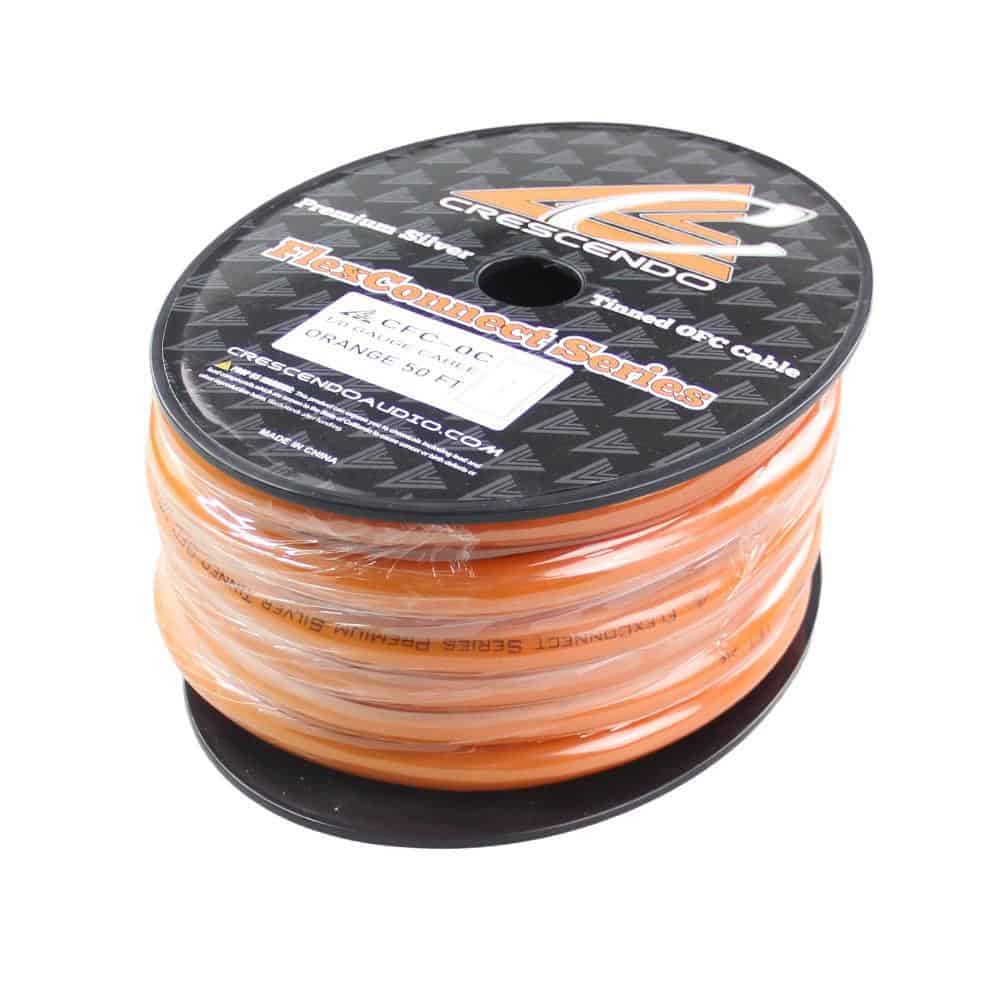
A 0 gauge wire kit is the single most important purchase in a high power car audio build. The amplifier is only as good as the wire feeding it, and a kit that skimps on copper or fusing will turn a 3,000 watt system into a 2,000 watt system with a hot wire under the carpet. This guide covers what a real kit includes, how to size it for your amplifier, and the difference between the OFC kits worth buying and the CCA kits that waste your money.
What Should a 0 Gauge Wire Kit Include?
A complete kit is more than a spool of power wire. Here is the checklist for a kit that will actually finish an install:
- Power wire. 15 to 20 feet of true 0 AWG, enough to route from the battery through the firewall and down the car to a trunk or under-seat amp.
- Ground wire. 3 to 5 feet of the same gauge. Short and fat is the rule for grounds.
- ANL or AGU fuse holder with fuse. The fuse is sized to the wire, not the amp. For 0 AWG OFC, that is typically 250 to 300 amps.
- Remote turn-on wire. 18 AWG, long enough to reach the head unit or a trigger source.
- RCA cables. A quality twisted pair set, not the thin molded cables that pick up alternator whine.
- Speaker wire. Enough to reach your subs, in a gauge that matches your power level.
- Ring terminals, distribution block, and hardware. The small parts that make or break an install.
If a kit is missing any of these, you are buying a partial kit and paying for the rest separately.
OFC vs CCA in a 0 Gauge Wire Kit
This is where most budget kits cut corners. A 0 gauge wire kit in CCA (copper-clad aluminum) costs half of what an OFC kit costs, and it performs like it. Aluminum conducts at about 61% of pure copper, so a CCA 0 AWG run has roughly 40% more resistance than a true OFC 0 AWG run. On a 2,000 watt system pulling 200 amps, that extra resistance shows up as voltage drop at the amp, heat in the wire, and reduced output on the low end.
There is a second problem with CCA kits: many of them are not even true 0 AWG. Budget manufacturers measure the jacket, not the conductor, and a “0 gauge” CCA kit can carry the same copper area as a 4 AWG OFC run. The wire looks right until you strip it.
For anything over about 1,000 watts RMS, buy the OFC kit. The price difference is real but small compared to the cost of the amplifier it feeds, and the OFC kit will deliver full current for the life of the install.
How to Size a Wire Kit by Amplifier Wattage
The gauge you need is determined by total RMS power and the length of the power run. For a 0 gauge kit, the math works out like this:
- 0 AWG OFC: 1,500 to 4,000+ watts RMS, runs up to 20 feet. This is the standard for big subwoofer amps and multi-amp systems.
- 4 AWG OFC: 500 to 1,200 watts RMS, runs up to 15 feet. The right call for a single mid-size sub amp.
- 4 AWG CCA: treat it as 6 AWG. If your kit is CCA, drop the rating one full gauge.
The rule of thumb: total up your amplifiers’ RMS ratings, add 20% headroom, and size the wire so the voltage drop stays under 3% at full tilt. A 0 gauge OFC run at 200 amps over 15 feet drops about 0.24 volts. The same run in CCA drops closer to 0.4 volts, and your amp’s output stage sees every one of those volts. If the drop is still too much with proper wire, a high output alternator is the next upgrade.
4 Gauge Amp Wire Kit: When 0 Gauge Is Overkill
Not every build needs 0 gauge. A 4 gauge amp wire kit is the right size for a single subwoofer amplifier in the 500 to 1,200 watt range, and it is dramatically easier to route through firewalls and door sills. A 4 gauge amplifier wiring kit in OFC carries about 150 amps safely, which covers a 1,000 watt RMS amp with headroom to spare.
The mistake people make is buying 0 gauge for a 600 watt amp because it looks serious. The wire is harder to route, the terminals are bigger, and you gain nothing. Match the kit to the amp: 4 gauge for up to about 1,200 watts, 0 gauge above that or for any system with two amplifiers.
Fusing: The Part Nobody Should Skip
The fuse in a wire kit is sized to protect the wire, not the amp. A 0 AWG OFC run gets a 250 to 300 amp ANL fuse at the battery. If the wire shorts to chassis, the fuse blows before the wire melts. If you skip the fuse or use one rated too high, a short turns the power wire into a heater and the car into a fire risk.
Install the fuse holder within 18 inches of the battery terminal. That way the entire run is protected, not just the section past the fuse.
Buying Guide: What Separates a Good Kit
- True AWG OFC. Verify the conductor cross section. Real 0 AWG OFC measures about 53 mm squared of copper.
- Flexible jacket. PVC and silicone blend jackets route cleanly and stay flexible in cold weather.
- Quality RCA cables. Twisted pair construction rejects noise. The molded single-core RCAs in cheap kits are the number one source of alternator whine.
- ANL fuse holder. ANL fuses are easier to source and replace than the oddball fuses some kits ship.
- Enough ground wire. A 3 foot ground is the minimum. Kits that ship 2 feet force bad grounding decisions.
Buy the best 0 gauge wire kit you can afford, in OFC, with a real fuse holder and quality RCAs. It is the one part of the install that touches every other part, and it is the cheapest insurance against voltage drop, noise, and melted wire. For smaller builds, a 4 gauge amp wire kit in OFC covers up to about 1,200 watts with easier routing.
If you are still deciding between OFC and CCA for the signal side, our OFC speaker wire guide breaks down the conductivity numbers and gauge sizing for speaker runs.
Ready to power it up? Shop 0 gauge wire kits and 0 gauge wire by the foot at Down4Sound, with true AWG OFC and complete kits built for real power.
0 Gauge Wire Kit FAQ
What comes in a real 0 gauge wire kit?
A real kit includes 15 to 20 feet of true 0 AWG power wire, 3 to 5 feet of ground wire in the same gauge, an ANL fuse holder with fuse, a remote turn-on wire, RCA cables, speaker wire, and the ring terminals and hardware to finish the install. If any of that is missing, you are buying a partial kit and paying for the rest separately.
What size fuse do I need for 0 gauge?
The fuse is sized to protect the wire, not the amp. A 0 AWG OFC run gets a 250 to 300 amp ANL fuse, mounted within 18 inches of the battery so the entire run is protected. A fuse rated too high turns a short into a fire risk.
Is 0 gauge big enough for 3000 watts?
Yes. A 3,000 watt RMS system draws roughly 250 amps at 14.4 volts, and 0 gauge OFC carries about 300 amps safely. That covers the system with headroom, as long as the kit is true AWG OFC and not undersized CCA.
Where do I ground the amp wire?
Ground to a solid chassis point as close to the amp as possible, using the same 0 gauge as the power run. Keep the ground short, around 3 feet, and make sure the contact point is clean bare metal. Short and fat is the rule for grounds.
Keep Reading
- OFC Speaker Wire: What It Is and Why It Matters
- Monoblock Amp Guide: What It Is and How to Choose One
- Car Audio Alternator Upgrade: Signs, Sizing, Install Tips
The right kit pairs true 0 gauge copper with fusing that protects the entire run. Shop the OFC power, ground, and speaker wire at Down4Sound, true AWG sizing in every gauge. Financing is available for builders who want the full kit on the car now and the payments later.