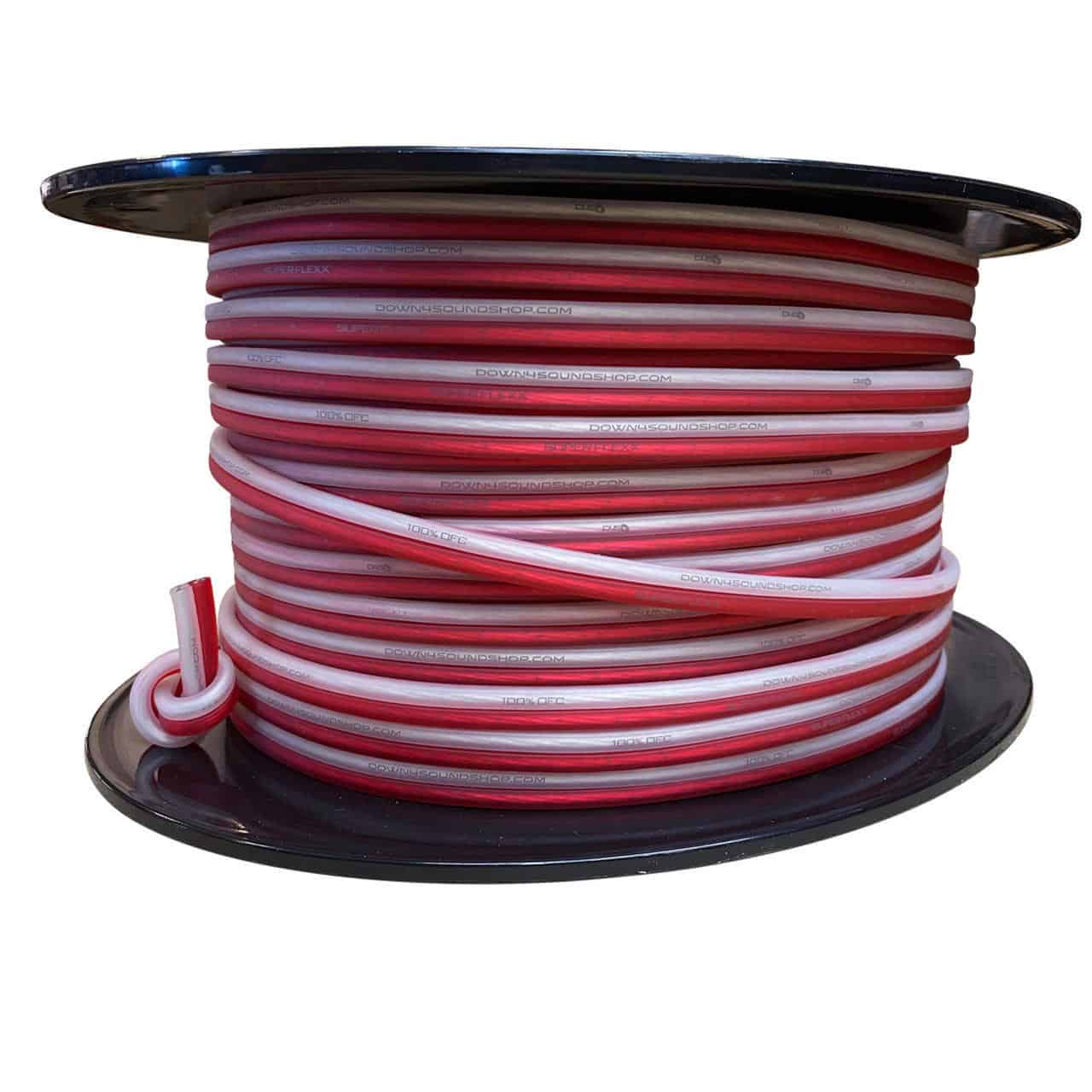
Oxygen-free copper (OFC) and copper-clad aluminum (CCA) are the two conductor types behind almost every car audio wire on the market. OFC is 99.95% pure copper drawn into hundreds of fine strands per conductor. CCA is an aluminum core with a thin copper cladding, built to hit a lower price per foot. Both will play music. What matters is knowing which one belongs where in your install, and that is what this guide covers: what each cable is, how strand count and size affect current delivery, and where tinned OFC fits in.
OFC vs CCA: The Numbers That Matter
The marketing around wire is full of vague claims, so here are the numbers that actually matter.
Conductivity. Pure copper conducts at roughly 100% IACS (International Annealed Copper Standard). CCA wire is an aluminum core with a thin copper plating, and aluminum conducts at about 61% IACS. That means for the same gauge, CCA carries roughly 40% more resistance per foot than solid OFC.
Resistance per foot. A 12 AWG OFC run measures around 0.0016 ohms per foot. The same 12 AWG CCA run measures about 0.0026 ohms per foot. Over a 20 foot round trip to a sub, that is 0.032 ohms of added resistance with OFC versus 0.052 ohms with CCA. On a 1 ohm subwoofer load, that extra 0.02 ohms is a real, measurable loss of damping and output.
Current capacity. Because CCA runs hotter at the same current, you need to jump roughly one gauge size to match OFC. A 4 AWG CCA power run carries about the same current as a 4 AWG OFC run only if you derate it, and most CCA wire sold as 4 AWG is actually undersized to begin with. Many budget kits label wire by the outer jacket diameter, not the actual copper cross section. A “4 AWG” CCA kit can have the same copper area as a real 6 AWG OFC run.
Corrosion. Copper and aluminum age differently at connection points. The aluminum core in CCA oxidizes where the cladding gets thin, especially at crimps and clamps, and that oxide is resistive, so connections can develop dropouts over years in humid conditions. OFC forms only a surface oxide that stays conductive enough for a good crimp to keep working. In dry interiors both age fine; in boats, doors, and coastal climates, tinned OFC (covered below) removes the concern entirely.
What Gauge OFC Speaker Wire Do You Need?
Gauge selection for speaker wire depends on power, impedance, and run length. For car audio, the practical rule is:
- 16 AWG OFC: up to about 100 watts RMS into 4 ohms, runs under 15 feet. Fine for tweeters and small coaxials.
- 14 AWG OFC: up to about 150 watts RMS into 4 ohms, or 100 watts into 2 ohms. The default for most midrange and component sets.
- 12 AWG OFC: up to about 300 watts RMS into 4 ohms, or 200 watts into 2 ohms. The standard for subwoofers on a monoblock amp in most builds.
- 10 AWG OFC: 300 to 600 watts RMS into 2 ohms or lower. For big subs, including dual 12 setups, and long runs.
- 8 AWG OFC: 600 watts and up, or any run over 25 feet to a sub. This is where you stop calling it speaker wire and start treating it like power wire.
If you are running a 1 ohm load, go up one gauge from the chart. Low impedance loads draw more current, and the voltage drop across a too-thin run shows up as lost output and a hot wire.
OFC 0 Gauge Wire: The Power Side
The same logic applies to your power wire, just with bigger numbers. A 0 gauge OFC wire run carries roughly 300 amps at a safe temperature rise, which covers everything from a 2,000 watt system to a serious competition build. The 0 gauge OFC wire sold by serious retailers is true AWG 0, with a copper cross section around 53 mm squared, not a fat jacket over a thin core.
For a 0 gauge run, the resistance is about 0.00008 ohms per foot. Over a 15 foot run from the battery to the trunk, that is 0.0012 ohms. At 200 amps of current draw, that is a 0.24 volt drop. The same run in CCA would drop closer to 0.4 volts, and your amplifier’s output stage sees every one of those volts. This is why high output alternator builds and big subwoofer systems spec OFC 0 gauge wire as the baseline.
How to Verify What You Are Buying
OFC and CCA are both easy to verify once you know what to look for.
- Check the copper cross section, not the jacket. Strip a sample and measure the bare conductor. A true 12 AWG OFC conductor measures about 2.05 mm diameter. If the bare conductor is visibly smaller than the label claims, the wire is undersized, whatever the jacket says.
- Scrape the conductor. OFC is copper colored all the way through. CCA shows a silver aluminum core the moment you scratch through the plating.
- Bend it. OFC is soft and takes a bend without springing back. CCA is stiffer and has a springy feel because of the aluminum core.
- Price it. If a “0 gauge OFC” kit costs the same as a CCA kit, check what the conductor actually is. Copper prices are public, so compare the kit price to the copper market before you buy.
Buying Guide: What to Look For in OFC Speaker Wire
When you shop for OFC speaker wire, the specs that separate good wire from junk are:
- True AWG sizing. The gauge stamped on the jacket should match the measured conductor diameter.
- Flexible jacket. A PVC and silicone blend jacket stays flexible in cold weather and routes cleanly through door boots and under carpet. Stiff PVC cracks and makes installs miserable.
- Strand count. More strands means more flexibility. 12 AWG OFC with 100+ strands bends like rope; 19 strand wire fights you in tight spaces.
- Color options. Red and black pairs make polarity obvious at the amp rack and the speaker terminals. It sounds trivial until you are troubleshooting a phase issue at 2 AM.
The short version: OFC anywhere the current matters, CCA where the budget demands it, tinned OFC anywhere moisture is in play. For the power side of the system, pair your wire with a proper 0 gauge OFC wire run and a real OFC speaker wire and cable selection sized to your amp.
If you are still deciding on the power side, our 0 gauge wire kit guide covers complete kits, fusing, and how to size the run for your amplifier’s current draw.
Strand Count: What It Tells You
Strand construction is the quickest physical tell between the two conductors. A 12 AWG OFC speaker lead is built from 100 or more fine copper strands, which is why it bends like rope around door boots and under carpet. CCA reaches its gauge with fewer, thicker aluminum strands, so it feels stiffer and springs back when you bend it. Strand count does not change conductivity on paper, but it decides how the wire routes in a real install and how well it survives being moved.
Tinned OFC: What the Tin Coating Does
Tinned OFC is standard OFC with every strand coated in a thin layer of tin before the jacket goes on. The tin seals the copper against oxidation, which matters anywhere moisture or humidity reaches the wire: boats, motorcycles, underbody amp racks, door cavities, and coastal climates. It also solders easier. You pay a small premium over bare OFC, and in exchange the conductor stays bright and low resistance for years. We stock tinned OFC across the full size range, from 16 gauge speaker leads to 1/0 power and ground.
Every Size and What It Is For
Wire size is current capacity. These are the working ranges we build with:
| Gauge | Type | Typical job |
|---|---|---|
| 18 AWG | Speaker | Tweeters and low power dash speakers |
| 16 AWG | Speaker | Coaxials and tweeters up to about 100 watts RMS |
| 14 AWG | Speaker | Midrange and component sets up to about 150 watts RMS |
| 12 AWG | Speaker | Subwoofers and high power mids up to about 300 watts RMS |
| 10 AWG | Speaker | Big subs and long runs past 300 watts RMS |
| 8 AWG | Power and ground | Mid size amps up to roughly 800 watts RMS |
| 4 AWG | Power and ground | Amps up to roughly 1500 watts RMS |
| 1/0 AWG | Power and ground | 2000 watts RMS and up, Big 3 upgrades, battery banks |
Every gauge above is available in OFC, and most in tinned OFC, in the full cable lineup at Down4Sound.
Wire Questions, Answered
Is OFC worth it over CCA for a daily driver system?
For a mild system under about 500 watts RMS with short runs, CCA speaker wire works and saves money. Past that point, or on any run you plan to keep for years, OFC earns its keep in lower resistance and connections that stay clean. Most daily builds land on OFC for the speaker runs because the price difference per install is small.
What does tinned OFC protect against?
The tin coating seals each copper strand from moisture and air, so the conductor resists oxidation in boats, motorcycle fairings, door cavities, and coastal humidity. If the wire lives anywhere damp, tinned OFC is the right call.
What gauge speaker wire do I need for 1000 watts?
For a sub drawing 1000 watts RMS at 2 ohms, 12 AWG OFC covers runs up to about 20 feet. Longer runs or 1 ohm loads step up to 10 AWG. On the power side, a 1000 watt amp wants 4 AWG OFC minimum.
Can I mix CCA power wire with OFC speaker wire?
You can, and plenty of budget builds do. The power run is where resistance costs the most, so if only one run gets upgraded to OFC, make it the power and ground. Speaker runs on CCA still play; OFC there just keeps more of the amp’s output at the terminals.
How can I tell OFC from CCA when shopping?
Check the conductor, not the jacket. Scrape a strand: copper colored all the way through is OFC, a silver core is CCA. OFC also bends softer thanks to its higher strand count, and honest sellers state the conductor material in the listing.
More Guides Worth Reading
- 0 Gauge Wire Kit Guide: What to Buy for Big Amps
- Monoblock Amp Guide: What It Is and How to Choose One
- 2 12 Inch Subs: Dual 12 Box, Amp, and Wiring Guide
Ready to wire it right? Shop the full OFC speaker wire and cable lineup at Down4Sound, with true AWG sizing and flexible jackets built for real installs.