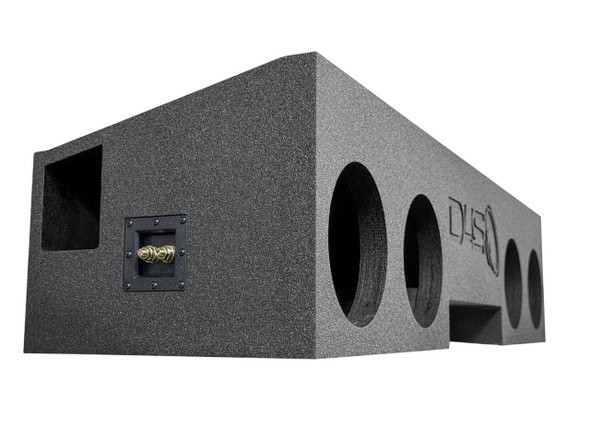
The subwoofer box is the single most important part of a bass system, and it is the part most people get wrong. You can run a $400 sub in a $60 prefab box and get outdone by a $150 sub in a properly sized enclosure. Whether you call it a subwoofers box, a speaker box, or an enclosure, this guide covers the real numbers that matter: net air space, tuning frequency, mounting depth, and build quality, so you can match a box to your subs instead of guessing.
Why the Box Matters More Than the Subwoofer
A subwoofer is a motor and a cone. The box is what controls how that motor behaves. Air inside the enclosure acts as a spring, and the size of that spring determines everything from low end extension to power handling to how the sub sounds at high volume.
Put a sub that wants 1.5 cubic feet into a 0.8 cubic foot sealed box and you get a stiff, peaky response with almost no low end. Put a sub designed for a small sealed box into a big ported enclosure and you risk unloading the cone below tuning, which is how subs get destroyed. The enclosure spec in the sub’s manual is not a suggestion. It is the tuning target.
Sealed vs Ported vs Bandpass
Every subwoofer box falls into one of three families, and each one trades something to get something else.
Sealed boxes are the simplest: a fully closed airspace, usually 0.8 to 1.5 cubic feet for a 12 inch sub. They give tight, accurate bass, a gradual low end rolloff, and the most forgiving power handling. A sealed box is the right call for sound quality builds and for anyone who plays a wide range of music. See our full breakdown of the tradeoffs in the sealed vs ported subwoofer box comparison
.
Ported boxes add a vent that is tuned to a specific frequency, usually 32 to 38 Hz for daily setups. The port adds output around tuning, often 3 dB or more, and extends the low end. The cost is a larger box, less control below tuning, and a box that is pickier about matching the sub. Ported is the standard choice for SPL and for anyone who wants the loudest possible output from a given sub and amp.
Bandpass boxes hide the sub inside the enclosure and let the sound come out through a ported chamber. They can be very loud in a narrow band, but they are the hardest to get right and the easiest to get wrong. Skip bandpass unless you know exactly what you are doing.
Air Space: Gross vs Net Volume
This is where most people get burned. A box that measures 2.0 cubic feet on the outside is not 2.0 cubic feet of air for the sub.
Gross volume is the total internal volume of the box before anything is subtracted. Net volume is what the sub actually sees: gross volume minus the sub’s displacement, minus the volume taken up by the port, minus bracing. A 2.0 cubic foot gross box with a big port and a 12 inch sub can easily net out to 1.4 cubic feet.
When a sub spec sheet says “1.25 cubic feet ported, tuned to 35 Hz,” that is net volume. If you buy a prefab box, check the listed net volume, not the outside dimensions. If you are building, use a box calculator and subtract the port and driver displacement before you cut wood.
Tuning Frequency and Port Design
Tuning frequency is the frequency the port is resonant at, and it shapes the whole response. A 32 Hz tune gives deep, musical low end. A 40 Hz tune gives a punchy, one-note feel that is popular for rap and SPL demos but rolls off fast below 40 Hz.
For a daily driver playing mixed music, 32 to 36 Hz is the sweet spot for a 12 inch ported box. For a dedicated SPL setup, 38 to 42 Hz trades low end for peak output. The port itself matters too: a slot port needs enough cross sectional area to keep port velocity down. If the port is too small, you get chuffing noise at high volume. A good rule of thumb is 12 to 16 square inches of port area per cubic foot of net volume for daily setups.
MDF and Build Quality
A subwoofer box is only as good as its wood and its joints. The standard is 3/4 inch MDF, and for good reason: MDF is dense, dead, and cuts clean. A quality MDF subwoofer box uses 3/4 inch material, glued and screwed joints, and internal bracing on any panel larger than about 18 inches. Thin particle board boxes flex, and a flexing panel steals output and adds distortion.
Check the seams on any box you buy. A good box has no gaps, no rattles, and a terminal cup that is sealed. If you can push on a panel and feel it give, the box is too thin or underbraced.
Speaker Boxes vs Subwoofer Boxes
There is a difference between a speaker box and a subwoofer box, and the terms get mixed up constantly. A speaker box for full range speakers is built around a different set of goals: midrange clarity, imaging, and a sealed or small ported chamber sized to the driver. A subwoofer box is built for low frequency output, high excursion, and port velocity.
If you are shopping for a box with speakers already loaded, check what is actually in it. Many budget loaded boxes pair a generic 12 inch driver with a box that is too small and a port that is too short. The box for speakers matters as much as the speakers themselves. A loaded box is only a deal if the enclosure is properly sized for the driver inside.
Matching the Box to Your Car
The best box in the world is useless if it does not fit your vehicle. Before you buy, measure the actual space: trunk opening, depth from the seat to the rear deck, and clearance around the spare tire well. A car speaker box that fits a sedan trunk will not fit a coupe, and a tall ported box will not fit under a hatchback’s cargo cover.
For trucks, the space under or behind the seat dictates everything, which is why vehicle specific boxes exist. For cars, a down firing or side firing box can save depth. Measure twice, then check the box’s outside dimensions against your measurements, including the port and the terminal cup.
Prefab vs Built to Order
Prefab boxes are the fastest way to get bass, and a good prefab is a legitimate option if the net volume and tuning match your sub. The problem is that most prefabs are generic: one box, tuned to one frequency, sold for every sub on the market. If your sub wants 1.5 cubic feet ported at 34 Hz and the prefab offers 1.25 at 40 Hz, you are leaving output and low end on the table.
Built to order boxes are sized and tuned to the exact sub you are running, and vehicle specific boxes are shaped to the actual space in your truck or car. That is why serious builds go custom. A box built to the sub’s spec will always outperform a generic box with the same sub and amp.
Ready to get the box right? Browse our full lineup of subwoofer boxes and enclosures, from prefab options to vehicle specific and built to order designs, and match the enclosure to your subs before you spend another dollar on gear.
Subwoofer Box Questions, Answered
How much air space does a 12 inch sub need?
Most 12 inch subs want 1 to 2 cubic feet of net air space, but the sub maker’s spec is the target. Sealed boxes for a 12 typically run 0.8 to 1.5 cubic feet, while ported boxes run larger. Net volume is gross volume minus sub displacement, port volume, and bracing, so check the listed net number, not the outside dimensions.
What is port tuning?
Port tuning is the frequency the port resonates at, and it shapes the whole response of a ported box. For a daily driver playing mixed music, tune to the low 30s Hz, around 32 to 36 Hz. Higher tunes near 40 Hz trade low end for peak output in SPL setups.
What thickness MDF should a sub box use?
3/4 inch MDF is the standard for subwoofer boxes. Joints should be glued and screwed, and any panel larger than about 18 inches needs internal bracing. Thinner material flexes, and a flexing panel steals output and adds distortion.
Does box shape matter for sound?
Shape matters far less than net volume and tuning. A box with the right net air space and tuning will perform whether it is a standard rectangle, a down firing design, or a vehicle specific shape. What matters is panel rigidity, solid joints, and a shape that actually fits your vehicle.
Keep Building
- 2 12 Inch Subs: Dual 12 Box, Amp, and Wiring Guide
- Shallow Mount Subwoofers: 8, 10, and 12 Inch Fitment Guide
- Subs for Trucks: Under Seat and Behind Seat Box Guide
Air space decides how the sub sounds, and tuning decides how low it digs. Get the volume right with the subwoofer boxes and custom enclosures at Down4Sound, including built to order designs for your exact vehicle. Financing is available so the correctly sized enclosure does not have to wait for next month.