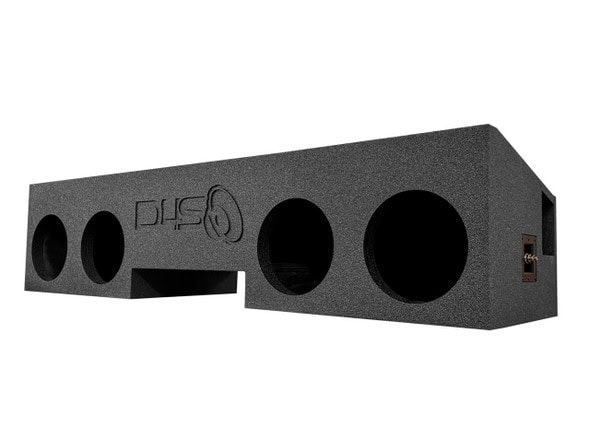
Subs for trucks are a different game than subs for cars. A truck cab has no trunk, the rear seat is often a bench that folds up, and the usable space is measured in inches of seat clearance, not cubic feet of trunk. The good news is that truck specific subwoofer boxes exist for nearly every popular pickup, and they are built to use the space you actually have. This guide covers the two main install locations, the air space math, and how to pick subs that work in a truck.
Why Trucks Need Different Subwoofer Boxes
A sedan trunk gives you a big, open cavity that a box can sit in. A truck gives you a seat bottom, a seat back, and a cab wall, all at odd angles. A generic rectangular box will not fit behind a truck seat, and it will not fit under one either. That is why vehicle specific boxes are shaped to the cab: they follow the seat contour, clear the seat brackets, and use every inch of depth available.
The other difference is air space. Truck installs are shallow, so the boxes are small, and small boxes need subs that are happy in small enclosures. That is why shallow mount subs and truck boxes go together so often. A shallow 10 or 12 in a properly sized truck box will outperform a full depth sub crammed into a box that is too small.
Under the Seat: The Crew Cab Standard
Under the rear seat is the most popular spot for truck subs, especially in crew cabs. The space under a rear bench seat is typically 4 to 6 inches tall, which is enough for a shallow sub in a thin box, or a down firing box with a full depth sub if the seat clearance allows.
Measure before you buy. Put the seat in its normal position and measure the gap between the floor and the seat bottom, front to back and side to side. Subtract carpet thickness and any seat brackets. A box that is 5 inches tall needs 5 inches of clearance, plus a little room so the seat does not press on the box and rattle.
Under seat boxes are usually sealed, because a sealed box can be built thinner than a ported one. A pair of shallow 10s in a sealed under seat box is the classic crew cab setup: it fits, it sounds good, and it leaves the cab usable. If you want ported output under the seat, look for a box specifically designed with a low profile slot port, and check the tuning before you buy.
Behind the Seat: Extended Cab and Crew Cab
Behind the rear seat is the other main location, and it is the one with more air space. The gap between the seat back and the cab wall is often 5 to 7 inches deep, which fits a shallow sub in a thin box, or a down firing full depth sub in a wedge box.
Behind the seat boxes are almost always vehicle specific, because the seat angle, the cab wall shape, and the seat belt mounts vary by truck. A box built for a Ford F-150 will not fit a Silverado, and even the same model changes between generations. Buy the box for your exact year and cab configuration.
Behind the seat gives you more room for air space, which means you can run a ported box tuned to 32 to 35 Hz and get real low end. A single 12 in a ported behind the seat box is a solid daily setup for an extended cab. A pair of 12s fits in crew cabs with deeper seats, but check the depth first: dual 12 boxes are tall, and the seat has to close.
Air Space Math for Truck Boxes
Truck boxes are small, so net volume matters more than ever. A behind the seat box might measure 1.5 cubic feet gross, but after the sub displacement, the port, and the angled panels, it nets out to 1.0 cubic foot. That is the number that matters.
Match the sub to the net volume. For sealed truck boxes, a 10 inch sub wants 0.5 to 0.8 cubic feet and a 12 inch sub wants 0.8 to 1.2 cubic feet. For ported truck boxes, a 12 wants 1.25 to 1.75 cubic feet tuned to 32 to 35 Hz. If the box you are looking at lists its net volume and tuning, compare it to the sub’s spec sheet. If it does not list them, ask, because a truck box with the wrong volume will sound bad no matter what sub you put in it.
Shallow vs Full Depth Subs in Trucks
Shallow mount subs are the obvious choice for under seat installs, and they are the right call when clearance is under 5 inches. The Sundown SML series is built for exactly this: the SML 10 and SML 12 handle 500 watts RMS each with roughly 3.5 inches of mounting depth, and they are happy in the small sealed boxes that fit under truck seats.
Full depth subs still have a place in trucks, but only where the space allows. Behind the seat with 6 to 7 inches of depth, a full depth 12 in a down firing box works. Under the seat, a full depth sub usually does not, because the box gets too tall. Match the sub type to the location, not the other way around.
Power and Wiring for Truck Bass
Truck cabs are small, so you do not need a monster amp to get loud. A single 12 on 500 to 800 watts in a properly tuned box will be plenty for most daily drivers. A pair of shallow 10s or 12s on 800 to 1200 watts is a serious setup that still fits under the seat. If you are upgrading the rest of the system at the same time, 6.5 speaker pods are the easy way to get your door speakers keeping up with the new bass.
Wiring in a truck is straightforward: run power through the firewall grommet, ground to a clean chassis point, and route signal to the amp. Keep the amp somewhere it can breathe. Under the seat works if the amp has clearance, but behind the seat or under the rear seat with a fan is better for sustained output.
Ready to put bass in your truck? Browse our vehicle specific subwoofer boxes for your make and model, and pair them with subs that match the enclosure’s air space.
Truck Subs: Quick Answers
What fits under a truck back seat?
The space under a rear bench seat is typically 4 to 6 inches tall, so a shallow mount sub in a thin sealed box is the standard answer. A pair of shallow 10s or a single shallow 12 fits most crew cabs. If your seat clearance allows, a down firing box with a full depth sub also works.
Do I need a truck specific box?
In almost every case, yes. Truck cabs have odd angles, seat brackets, and belt mounts that vary by make, model, and generation, so a generic rectangular box will not fit correctly. A vehicle specific box is shaped to your exact cab and uses every inch of available depth.
How do I measure under seat space?
Put the seat in its normal position and measure the gap from the floor to the seat bottom, then measure front to back and side to side. Subtract carpet thickness and any seat brackets from your numbers. Leave a little extra room so the seat does not press on the box and rattle.
What amp works for a truck sub setup?
A compact monoblock is the natural truck amp: it fits under or behind a seat and drives one or two subs cleanly. A single 12 on 500 to 800 watts is plenty for most daily drivers. A pair of shallow subs on 800 to 1200 watts is a serious setup that still fits the space.
More Guides Worth Reading
- Custom Subwoofer Enclosures: Built to Order Box Guide
- Subwoofer Boxes: Air Space, Tuning, and Fit Explained
- Sealed vs Ported Subwoofer Box: Which Is Right for You?
Your cab has room for real bass once the box is shaped for the space under or behind the seat. Shop the vehicle specific subwoofer boxes at Down4Sound. Financing is available and the whole truck setup can split into easy monthly payments.