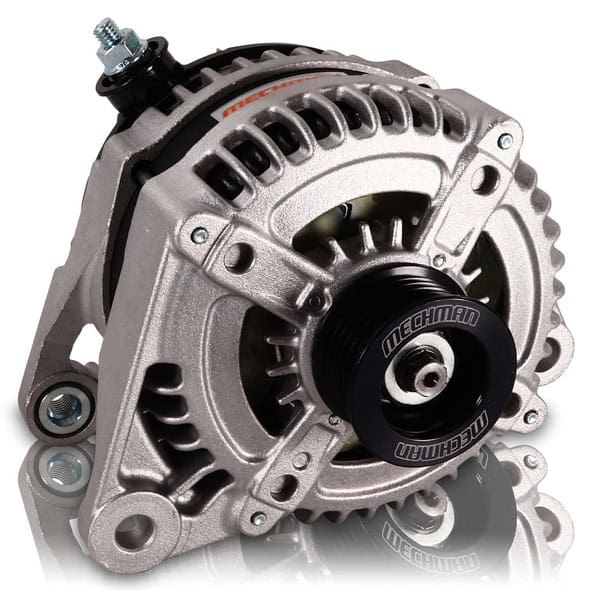
A high amp alternator is built to deliver more current than the factory unit, typically 200 amps and up, with output held at idle as well as at speed. If your car audio system dims the lights, drops voltage under bass, or kills stock alternators, this is the fix. This guide compares the common amp ratings, explains the specs that separate a good unit from a bad one, and tells you what to check before you order.
What Makes an Alternator “High Amp”?
The factory alternator on most cars and trucks is rated 90 to 150 amps. A high amp alternator starts where the stock unit tops out. The build differs from a stock unit in three ways:
- A heavier stator winding that carries more current without overheating
- Higher rated diodes in the rectifier that survive sustained load
- Better bearings and a rotor balanced for continuous high output
The rating is not a marketing number. A quality unit is bench tested at full load before it ships, and the idle output is published. If a seller cannot tell you the idle output, treat the max rating with suspicion.
Comparison: 250 vs 320 vs 400 Amp
250 amp alternators are the entry point for car audio. They suit systems up to about 1,500 watts RMS, fit most engine bays, and are the easiest install. If you are replacing a stock alternator that keeps dying under a moderate system, a 250 amp unit is the sensible step up.
320 amp alternators are the sweet spot for serious daily systems. They handle 1,500 to 3,000 watts RMS with headroom, and they are the most popular rating for builds running two amplifiers. The 320 amp high output alternator for Ford 6.2L is a good example of a vehicle-specific unit in this class.
400 amp alternators are for competition and demo builds. They handle 3,000 watts RMS and up, but they are physically larger, need more belt grip, and often require a battery bank to smooth the load. The 400 amp high output alternator for GM trucks is a proven unit in this class.
The Specs That Matter
Idle output. The max rating is measured at high RPM. At idle, a stock alternator makes half its rating or less. A good unit makes 60 to 80 percent of its rating at idle. For car audio, idle output is the spec that keeps voltage stable at stoplights.
Voltage setpoint. Most units in this class charge at 14.4 to 14.8 volts. That is correct for AGM batteries. Lithium battery banks need a lower setpoint or an external regulator, so match the alternator to your battery chemistry.
Case size and fitment. A 400 amp unit is bigger than a 250 amp unit. Check engine bay clearance, belt routing, and the connector style for your vehicle before you order. A reputable seller confirms fitment before shipping.
Pulley size. A smaller pulley spins the alternator faster, which raises idle output, but it also raises the risk of belt slip at high RPM. Quality units are matched to the vehicle’s belt system, not just bolted on.
Do You Need One or Just Better Wiring?
Before you spend on an alternator, check the wiring. If your system has factory gauge power wire, undersized grounds, or a corroded battery terminal, fix that first. The Big 3 upgrade (alternator positive to battery, battery negative to chassis, engine block to chassis) with 1/0 or 2/0 OFC wire solves a surprising number of voltage problems.
If the wiring is solid and the voltage still sags under bass, the alternator is the bottleneck. A high output unit plus the Big 3 upgrade is the complete fix. Doing one without the other leaves a weak link in the system.
vs Capacitor vs Second Battery
These get compared a lot, and they are not the same tool:
- A capacitor smooths voltage dips for a fraction of a second. It does not add charging capacity.
- A second battery adds reserve for short bursts. It does not add charging capacity.
- A high amp alternator adds charging capacity. It is the only one of the three that fixes the root cause.
Batteries and caps have their place in a finished system, but they are not substitutes for alternator capacity. If the alternator cannot replace what the system uses, everything downstream just drains.
High Amp Alternator FAQ
How many amps does a 3000 watt system actually need?
A 3000 watt RMS system draws roughly 250 amps at 14.4 volts before the vehicle’s base load. Add the 40 to 60 amps a modern vehicle needs for its own electronics, fuel pump, and fans, and you are at or past 300 amps under full tilt. That is why a 320 amp unit is the realistic floor for that power level.
Is a 400 amp alternator too much for a daily driver?
No. An alternator only makes the current the system asks for, so extra capacity does not force anything into the electrical system. The tradeoffs are cost, physical size, and belt load. If your daily is under 3,000 watts RMS, a 320 amp unit is usually the smarter spend.
What is idle output and why does it matter more than max output?
Idle output is the current the alternator makes at engine idle, where daily driving spends most of its time. The max rating is measured at high RPM, a number you will rarely see on the street. A good high amp unit holds 60 to 80 percent of its rating at idle, and that is what keeps voltage stable at stoplights.
Will a high amp alternator work with my factory wiring?
It will bolt in and charge, but factory gauge power wire cannot carry the extra current safely. Do the Big 3 upgrade with 1/0 or 2/0 OFC wire at the same time, and fuse the new run within 18 inches of the battery. That protects the vehicle and lets the alternator deliver what you paid for.
More Guides Worth Reading
- High Output Alternator Guide: Sizing, Specs, Buying Tips
- Car Audio Alternator Upgrade: Signs, Sizing, Install Tips
- How Much Is a New Alternator? Real Prices
A purchase this important deserves real specs, honest output ratings, and fitment support. Browse the high output alternators at Down4Sound, with fitment confirmed before anything ships. Financing is available if you would rather put the budget into the build and pay over time.